
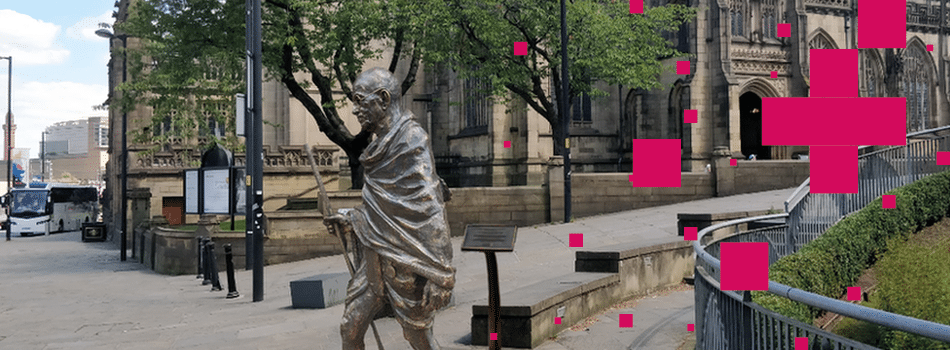
Walk through Manchester’s Medieval Quarter today and you’ll find a striking bronze figure standing outside the Manchester Cathedral. A statue of Mahatma Gandhi, in his traditional dhoti and shawl, astride with a large walking stick. The statue prompts a natural question of why a statue of Ghandi in central Manchester? The answers lie in a remarkable moment of shared hardship and diplomacy, between local mill workers and India’s famous independence leader.
In 1931, Manchester and Lancashire’s textile industry, once the beating heart of Britain’s industrial age, were in steep decline. Cheap international exports and a global economic downturn had already weakened the mills, but the decline was intensified by Gandhi’s Swadeshi movement, which encouraged Indians to boycott foreign cloth and revive their local industries. The movement was a cornerstone of India’s push for self-reliance, but its impact on Britain’s manufacturing was severe. It saw Lancashire and Manchester’s mills, which were seen as out of date and expensive in comparison, outpriced by the international markets like India. Unemployment soared and families across Manchester, Preston, Blackburn, and Darwen faced abject poverty.
Industrialists and trade unionists alike were scrambling for answers, and Indian nationalists still carried resentment over decades of British suppression of their own textile industry. Tensions between the two regions were at their peak. Gandhi was in Britain for the Round Table Conference, which was a major political negotiation on India’s future. He insisted on taking time away from Westminster to visit Lancashire and Manchester, the regions most affected by his boycott through the Swadeshi movement.
In September 1931, he arrived in Lancaster and was met with a warm welcome from local people. When Gandhi arrived at Spring Vale near Darwen, thousands of people gathered hoping to see him. He met the Mayors of Darwen and Preston, toured mills across Manchester, spoke with traders and journalists, and walked through the factories his movement had helped bring to a standstill. He stayed with local families during his visit, many of which are marked with blue plaques now. Gandhi’s visit didn’t reverse the economic crisis, nor did it immediately shift British policy, but it built mutual respect and open dialog between two communities.
In 2019, to mark the 150th anniversary of Gandhi’s birth, Manchester unveiled a permanent tribute: a 9-foot bronze statue sculpted by renowned artist Ram V. Sutar. Gifted by the Shrimad Rajchandra Mission Dharampur, it honours Gandhi’s philosophy of nonviolence and his historic connection to the region. Its placement outside Manchester Cathedral is symbolic. After the tragic 2017 Manchester Arena attack, the city embraced messages of unity, a key message in Ghandi’s work. Today, the statue stands as a reminder of the visit in 1931, and as a testament to Manchester’s multicultural, multi-faith identity and its commitment to peace in the face of adversity.