
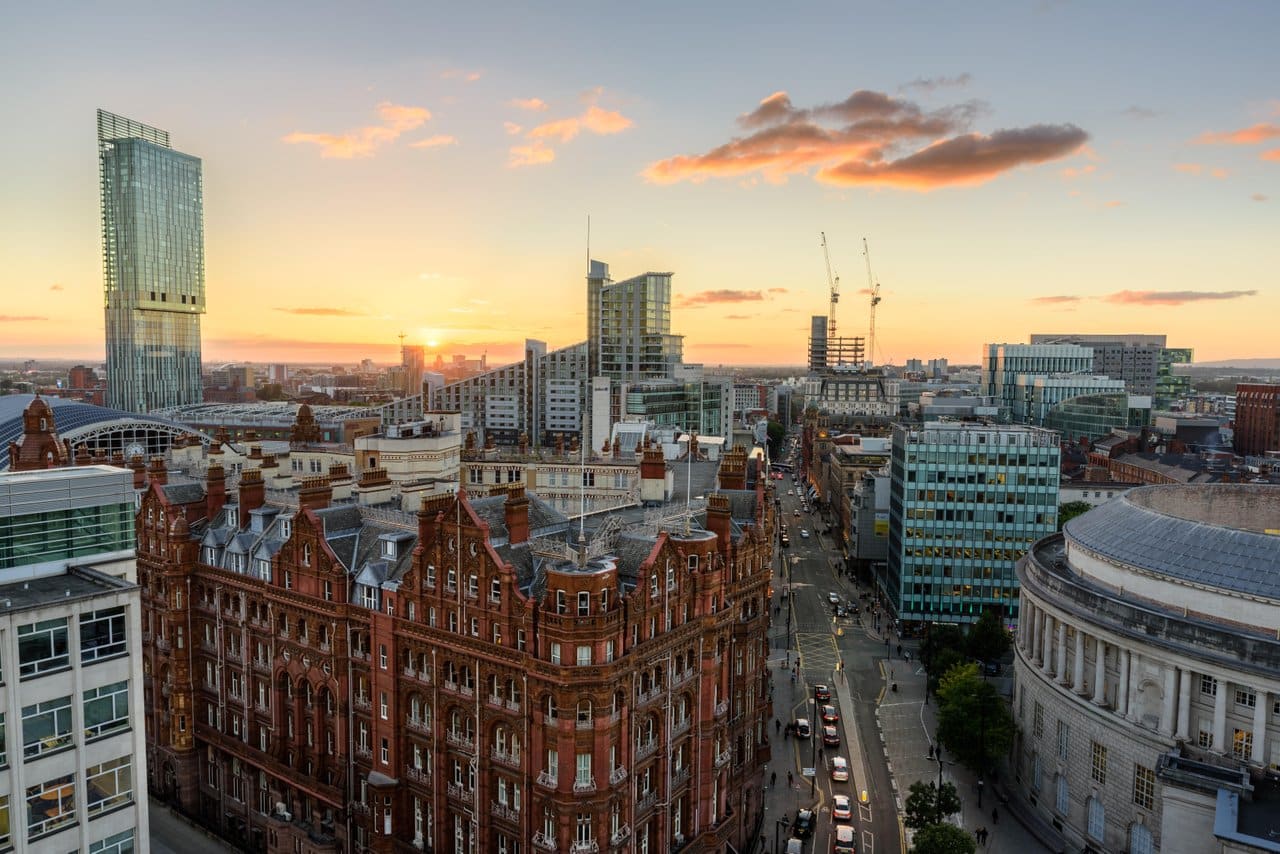
Manchester is one of the few UK city regions well placed to progress nuclear medicine capability, and for US companies thinking about where Europe’s next major radiopharmaceutical hub is taking shape, it is worth paying close attention to what is happening in Manchester.
The global radiopharmaceutical market is set to reach nearly $14bn by 2033, growing at 7-10% per year. The shift towards precision diagnostics and targeted therapies is accelerating demand, with molecular radionuclide therapy expected to play a growing role in cancer treatment over the next decade.
Countries are now investing in building their own nuclear medicine capability from the ground up, including the United States, Europe and emerging hubs in Asia-Pacific. The UK is one of the countries in Europe working towards this, and Greater Manchester is well placed to support that effort, with many of the key ingredients needed to make it happen.
What Manchester Brings
If you look at what a city region needs to make nuclear medicine work at scale, Greater Manchester has it. The University of Manchester, the Christie NHS Foundation Trust, the largest single-site cancer centre in Europe, treating more than 60,000 patients a year, Health Innovation Manchester, the Oxford Road Corridor, and Manchester Science Park have built the kind of cross-sector collaboration that the nuclear medicine pathway requires. Getting from isotope production to clinical application is complex and heavily regulated, requiring academia, industry and healthcare to work closely together at every stage. What makes it work here is that these organisations actually talk to one another to collaborate, and that is rarer than it should be.
Health Innovation Manchester brings together NHS, academic and industry partners to support clinical adoption, trial design, pathway development and the translation of new diagnostic and therapeutic products. That, alongside Manchester’s wider health innovation ecosystem, strengthens the city region’s offer for radiopharmaceutical development and clinical trials.
What also sets Manchester apart is the range of expertise sitting behind its life sciences ecosystem. The city region is also home to over 8,000 advanced manufacturing companies, with particular strengths in nuclear engineering, advanced materials, robotics, and AI-driven manufacturing.
Why logistics matters more than people think
Medical isotopes decay, and that shapes every operational decision a radiopharmaceutical company makes about where to locate. Around 60% of UK medical radioisotopes are imported, with nearly all therapeutic isotopes sourced from overseas, and that reliance on imports is a vulnerability the sector has already felt. Recent supply disruptions in Europe have underlined what is at stake when domestic production capability is absent.
To put the infrastructure gap into context, the UK has around one PET-CT camera per 600,000 people and one cyclotron per 2.5 million, compared to one per 130,000 and one per 1.3 million, respectively, in the US. For patients, that means access to diagnostics and therapies can depend on where you happen to live, and that is something we are determined to change.
Manchester Airport, with existing capability in time-sensitive international logistics and direct connections to international markets, is one of the few UK locations equipped for the time pressures nuclear medicine logistics demand, with connections to around 200 destinations including major life science hubs in Boston, Switzerland and Singapore.
The UK’s best-connected science, innovation, and manufacturing campus, MIX Manchester, located directly adjacent to the airport, takes that further. It brings together isotope production, GMP-compliant manufacturing, clinical trials, AI-enabled diagnostics and workforce development in a single location. With a proposed global air freight hub on site, MIX Manchester has the potential to provide the infrastructure the radiopharmaceutical sector needs and that the UK currently lacks.
The European opportunity
Manchester’s position is that we are not just building something for Manchester; the ambition is to anchor a UK-wide network, with regional hubs connecting into a central supply chain and improving access to diagnostics and treatment right across the country. If you look at the ingredients needed to make that happen, including land, talent, logistics, regulatory expertise, and industrial scale to serve national and international demand, Manchester has them all. Its devolved governance means companies can engage with stakeholders across local government, the NHS, and national partners and for any company that has tried to navigate a complex regulated environment across multiple stakeholders, you will know how much that matters.
The University of Manchester and the University of Salford are already developing new full-time courses in radiopharmaceutical sciences, with plans for delivery from 2026, with more than 120,000 students in the city annually and around half choosing to stay after graduating. Manchester also draws on 7.5 million working-age people within an hour’s travel of the MIX Manchester site, giving companies the scale of recruitment they need to grow.
For US companies thinking about Europe
Manchester offers clinical infrastructure, including The Christie, one of Europe’s largest cancer centres, a strong research and trials pipeline supported by large-scale integrated health data, nuclear engineering and manufacturing capabilities, and logistics access through Manchester Airport and MIX Manchester.
The UK’s nuclear medicine opportunity is real, it is growing, and Manchester is well placed to lead it.
If you are attending BIO International in San Diego this June, come and find us to discuss Manchester’s offering further, we are at booth 2221. Or visit Welcome to Manchester – Invest in Manchester to find out more.